Games can offer meaningful engagement for people living with Alzheimer’s and related dementias. When chosen with care, the right activities can spark familiarity, encourage connection, and create moments of joy without pressure or frustration. For adult children supporting a loved one, simple games can also provide a shared experience that feels natural and comforting.
In this guide, we share seven gentle, effective games for dementia that support connection, memory recall, and engagement. These activities are commonly used in thoughtful Memory Care settings, including communities that follow approaches like Allegro’s Ensemble Memory Care program.
Key Takeaways: Encouraging Connection and Engagement Through Games for Those With Dementia
-
The best games for dementia focus on familiarity, success, and emotional comfort
-
Simple activities can support connection even when verbal communication becomes difficult
-
Games should be adapted to the individual’s abilities, not the other way around
-
Group and one-on-one games both play an important role in Memory Care engagement
-
Structured programming can help ensure activities remain meaningful as needs change
Table of Contents
Why Games Matter for People With Dementia
Types of Games for Dementia Behaviors
How Memory Care at Allegro Supports Meaningful Engagement
Why Games Matter for People With Dementia
As dementia progresses, traditional conversation and complex activities may become more difficult. Games offer a different way to connect. They provide structure, predictability, and a sense of accomplishment. Most importantly, they create moments where a person feels capable, included, and at ease.
In Memory Care, games are selected not to challenge or test, but to support emotional well-being and presence in the moment.
Types of Games for Dementia Behaviors
In Memory Care, games are selected not to challenge or test, but to support emotional well-being and presence in the moment, such as:
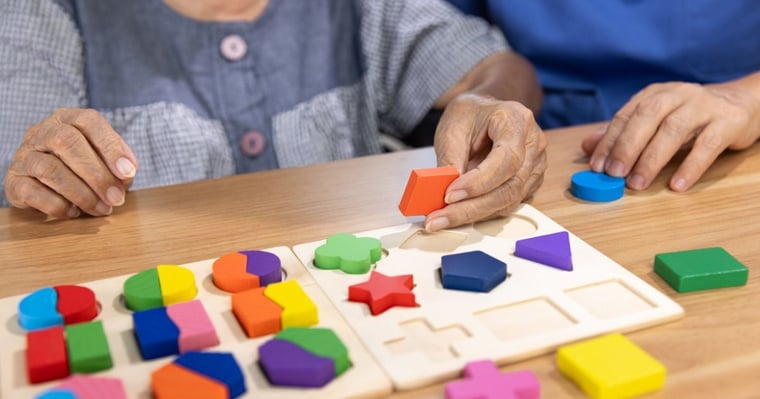
1. Matching and Sorting Games
Matching colors, shapes, or familiar objects helps support focus and visual recognition. These games work well one-on-one and can be easily adapted by reducing choices or using familiar household items.
Why it works: Clear goals and immediate success help reduce frustration while improving brain health.
2. Music Trivia and Sing-Along Games
Music often reaches parts of memory that remain strong even as dementia advances. Simple music trivia, lyric prompts, or group sing-alongs encourage participation and emotional connection.
Why it works: Music supports memory recall and creates shared joy without requiring explanation.
3. Picture Bingo
Picture bingo replaces numbers with images such as animals, food, or everyday objects. It maintains the familiar rhythm of bingo while reducing cognitive strain. Games like Go Fish, matching pairs, or sorting cards by color can be enjoyable with modified rules and large print cards.
Why it works: Card games feel familiar and social without requiring complex strategy.
4. Reminiscence Games
Reminiscence games use prompts related to past experiences such as first jobs, favorite holidays, or childhood activities. These games focus on long-term memories rather than recent recall.
Why it works: Older memories are often easier to access and comforting to revisit.
5. Movement and Ball Games
Gentle movement games like rolling a soft ball, balloon volleyball, or seated toss games support coordination and energy release.
Why it works: Physical movement paired with play supports mood and reduces restlessness.
6. Puzzles With Large Pieces
Puzzles with fewer, larger pieces and familiar images provide a calming, focused activity. Floor puzzles or tabletop trays work especially well.
Why it works: Clear visuals and manageable steps encourage success.
How Memory Care at Allegro Supports Meaningful Engagement
In a Memory Care setting, activities are thoughtfully planned and adapted to meet residents where they are. Programs like Allegro’s Ensemble Memory Care focus on creating daily moments of purpose through music, movement, creativity, and connection.
Rather than relying on one activity, our specially trained Memory Care teams create a rhythm of engagement that supports emotional comfort and dignity throughout the day. Download the Memory Care Guide to learn more about supportive programming, daily routines, and what to look for when choosing the right community.

 Planning Resources



 Events


 View our Communities
 Talk with an Advisor




.png?width=450&height=250&name=Questions%20to%20Ask%20to%20Find%20the%20Best%20Memory%20Care%20Community%20for%20Your%20Loved%20One%20(1).png)
.jpg?width=450&height=250&name=Allegro%208-15-23_What%20Is%20Memory%20Care%20(1).jpg)
Comments